Lesson 4
Collections, Indexing, and Slicing
Big question
How should related values be organized so that the structure communicates what operations are legitimate?
Lesson progress
Complete checkpoints as you learn
Learning objectives
- Use lists, tuples, dictionaries, and sets.
- Index and slice ordered collections.
- Build nested structures.
- Choose a collection based on meaning rather than habit.
- Prerequisites: Chapter 3.
- Key terms: list, tuple, dictionary, set, index, slice.
Simple explanation
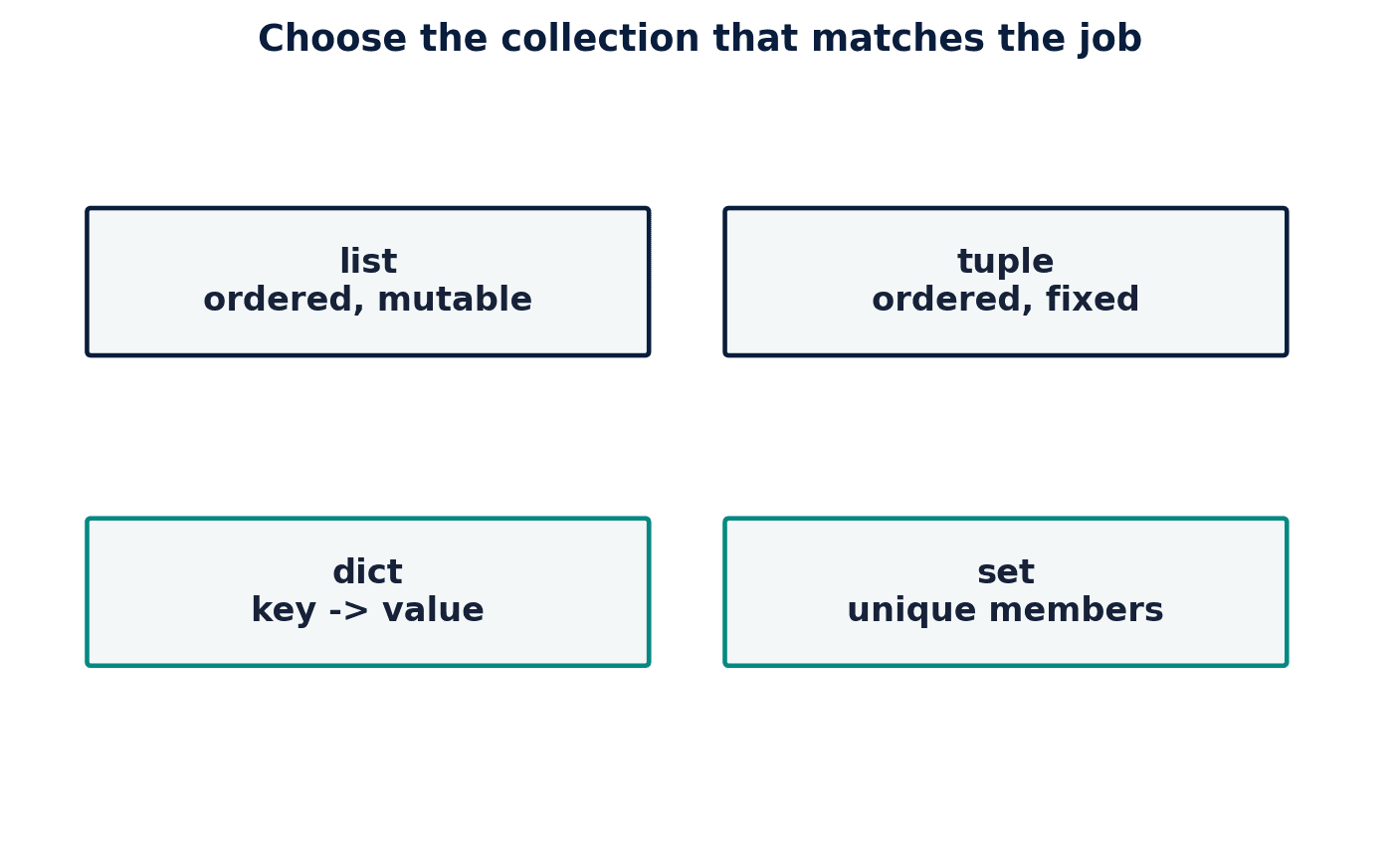
A list promises order and permits change. A tuple promises order and is normally treated as fixed. A dictionary maps unique keys to values. A set stores unique elements without meaningful position. These distinctions are analytical: a portfolio of ticker weights is naturally a dictionary, a fixed coordinate may be a tuple, and a sequence of monthly returns is a list until it becomes a NumPy array or pandas Series.
Key terms
- lists, tuples, dictionaries, and sets
- A core idea in Chapter 4 that students apply carefully in economic analysis.
- Index and slice ordered collections
- A core idea in Chapter 4 that students apply carefully in economic analysis.
- Build nested structures
- A core idea in Chapter 4 that students apply carefully in economic analysis.
- Choose a collection based on meaning rather than habit
- A core idea in Chapter 4 that students apply carefully in economic analysis.
- Prerequisites: Chapter 3
- A core idea in Chapter 4 that students apply carefully in economic analysis.
- Key terms: list, tuple, dictionary, set, index, slice
- A core idea in Chapter 4 that students apply carefully in economic analysis.
Analytical workflow
Interpret the expression in words and units before using it in a claim.
Example
Interpretation. The slice includes positions 1, 2, and 3, but not 4.
Prerequisites
- Complete the preceding course chapters or review their summaries as needed.
Full theory and examples
4.2
Four structures, four promises
A list promises order and permits change. A tuple promises order and is normally treated as fixed. A dictionary maps unique keys to values. A set stores unique elements without meaningful position. These distinctions are analytical: a portfolio of ticker weights is naturally a dictionary, a fixed coordinate may be a tuple, and a sequence of monthly returns is a list until it becomes a NumPy array or pandas Series.
4.3
Indexing is positional, slicing is a window
Python begins indexing at zero. The first element is therefore position 0, while -1 means the last element. Slices use a half-open interval: the starting position is included and the stopping position is excluded. That design makes lengths predictable, because values[a:b] contains b-a positions when the bounds are valid. The same convention appears in strings, arrays, and many pandas operations.
4.4
Comprehensions compress a transformation
List and dictionary comprehensions express a simple transformation or filter in one readable line. They are useful when the logic is short and transparent. A comprehension with several nested conditions becomes a puzzle and should be replaced by a loop or function. Readability is not cosmetic; it allows the analyst to inspect whether a data transformation matches the intended research rule.
4.5
Python demonstrations
4.5.1
Demonstration 4.1: Index and slice a return series
Verified output
Interpretation. The slice includes positions 1, 2, and 3, but not 4.
4.5.2
Demonstration 4.2: Map assets to weights
Verified output
Interpretation. A dictionary preserves the relationship between each asset label and its weight.
4.6
Visual evidence
4.7
Reference table
Why This Matters
Collection choice makes assumptions visible before the data reach a model.
Common Mistake
Using a set when order matters. A set is excellent for membership tests but cannot represent a time sequence.
Ceteris LAB Tip
Say the structure aloud: “a mapping from series name to unit” suggests a dictionary; “an ordered sequence of returns” suggests a list or array.
R-to-Python / Source Bridge
The old notes introduced vectors and matrix-like objects early. Python separates general-purpose collections from numerical arrays, which are introduced in Chapter 8.
| Structure | Ordered? | Duplicates? | Best use |
|---|---|---|---|
| list | Yes | Yes | changeable sequence |
| tuple | Yes | Yes | fixed record or coordinate |
| dict | Insertion order | Keys unique | named mapping |
| set | No positional meaning | No | membership and uniqueness |
Visual evidence
Additional Python demonstrations
Live Python
Source demonstration 2
Source demonstration 2
Stdout
Run Python to see results here.
Status / stderr
Ready to run Python in your browser.
Line-by-line guide
- Line 1Create or update a Python object used in the analysis.
- Line 2Display a result so students can inspect the output.
- Line 3Create or update a Python object used in the analysis.
- Line 4Display a result so students can inspect the output.
Verified source output
0.012
-0.011
[-0.004, 0.009, 0.003]
1.0
['BOND', 'EQUITY']
0.012 -0.011 [-0.004, 0.009, 0.003]
1.0 ['BOND', 'EQUITY']
Interpretation. The slice includes positions 1, 2, and 3, but not 4.
Interpretation. A dictionary preserves the relationship between each asset label and its weight.
Guided practice
- 1Re-run Demonstration 4.1 and change one input while keeping the analytical question fixed.
- 2Explain in two sentences how the output supports, or fails to support, the chapter opening question.
- 3Add one validation check that would prevent a plausible error.
Exercises
- 1Create a list of five GDP growth rates and print the middle three.
- 2Create a tuple containing a series ID and frequency.
- 3Create a dictionary mapping three variables to units.
- 4Use a set to remove duplicate province codes.
Source and downloads
Chapter 4 of Fundamentals of Python for Financial Econometrics by Mohammad Safavi, Ph.D.. The lesson is an original Ceteris Lab web adaptation of the supplied publication package.
Live Python
Collections, Indexing, and Slicing: live Python
Collections, Indexing, and Slicing: live Python
Stdout
Run Python to see results here.
Status / stderr
Ready to run Python in your browser.
Line-by-line guide
- Line 1Create or update a Python object used in the analysis.
- Line 2Display a result so students can inspect the output.
- Line 3Display a result so students can inspect the output.
- Line 4Display a result so students can inspect the output.
Python walkthrough
- 1`returns = [0.012, -0.004, 0.009, 0.003, -0.011]`: Creates or updates a named object used by later steps.
- 2`print(returns[0])`: Displays a result so it can be checked and interpreted.
- 3`print(returns[-1])`: Displays a result so it can be checked and interpreted.
- 4`print(returns[1:4])`: Displays a result so it can be checked and interpreted.
Live notebook
Run this lesson as a notebook
Open an editable notebook cell-by-cell, run Python in the browser, and download the `.ipynb` file for later.
Related dataset
Ceteris Lab teaching sample
Estimated time
25 to 40 min
Packages
pandas, numpy
Expected output
Printed Python results that can be compared with the lesson explanation.
Learning goals
- Load and inspect Ceteris Lab teaching sample.
- Run the Python cells connected to Collections, Indexing, and Slicing.
- Interpret the output using lists, tuples, dictionaries, and sets and Index and slice ordered collections.
Common errors
- File not found: check that wage_sample.csv is installed or use the course data folder.
- Package import error: use the browser notebook first, then download for local Jupyter if your local packages differ.
- Column name error: compare your variable names with the dataset variables listed for this notebook.
Dataset path helper
import pandas as pd

df = pd.read_csv("/data/wage_sample.csv")
df.head()
Interactive activity
Chapter 4 interactive
Reproducible Python decision lab
Which step should come before trusting a successful Python run?
Immediate feedback
Choose a decision, then test how the claim changes as evidence becomes stronger or weaker.
Try it yourself
Write one plain-English sentence explaining the main idea from this lesson.
Common mistakes
Check these before you move on.
Return to the lesson assumptions, units, diagnostics, and source evidence to replace this shortcut with a defensible interpretation.
Quick quiz
Which statement best answers the Chapter 4 opening question: How should related values be organized so that the structure communicates what operations are legitimate?
Quick quiz
Which practice should be avoided when applying Collections, Indexing, and Slicing?
Quick quiz
What is the most defensible way to interpret the Python demonstration?
Quick quiz
Why does Chapter 4 matter in an applied econometrics workflow?
Key takeaway
Lists, tuples, dictionaries, and sets encode different structural assumptions. Zero-based indexing and half-open slicing recur throughout Python. Comprehensions are best kept simple.